
Author: arbeam
-
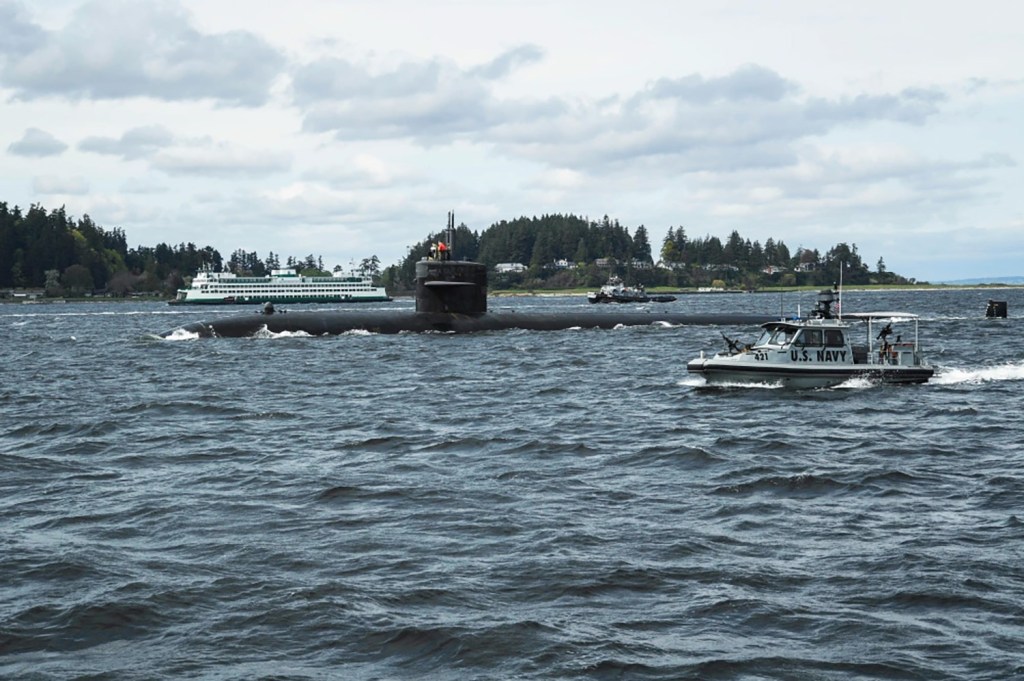
Good Bye USS Bremerton
This is the video I made for the 2018 reunion, a compilation of shots set to music. Just in case you wanted to see the last run pulling into port (USS Bremerton, WA) before she was deactivated. – Rich Crombie.
-
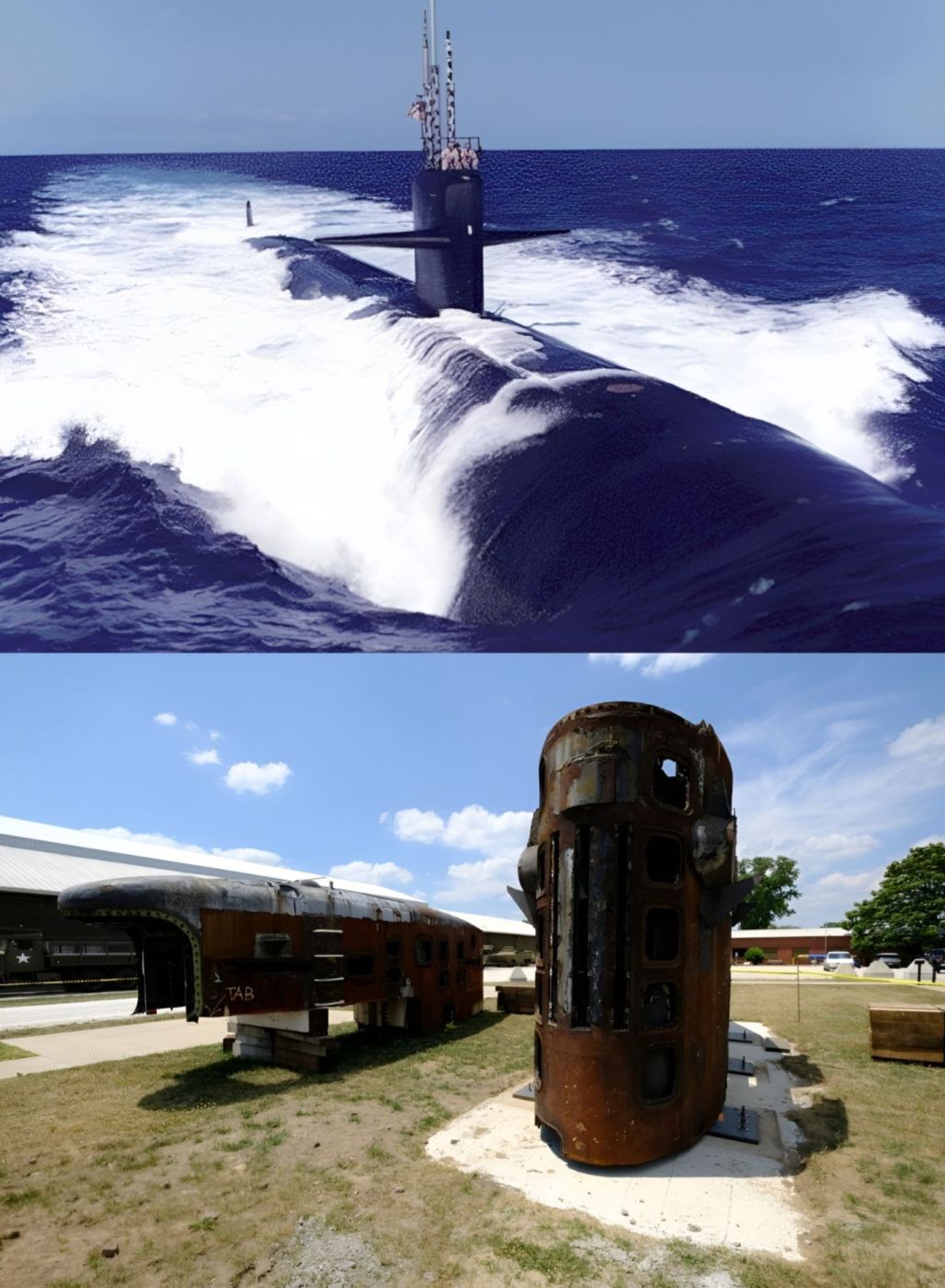
USS Indianapolis (SSN-697)
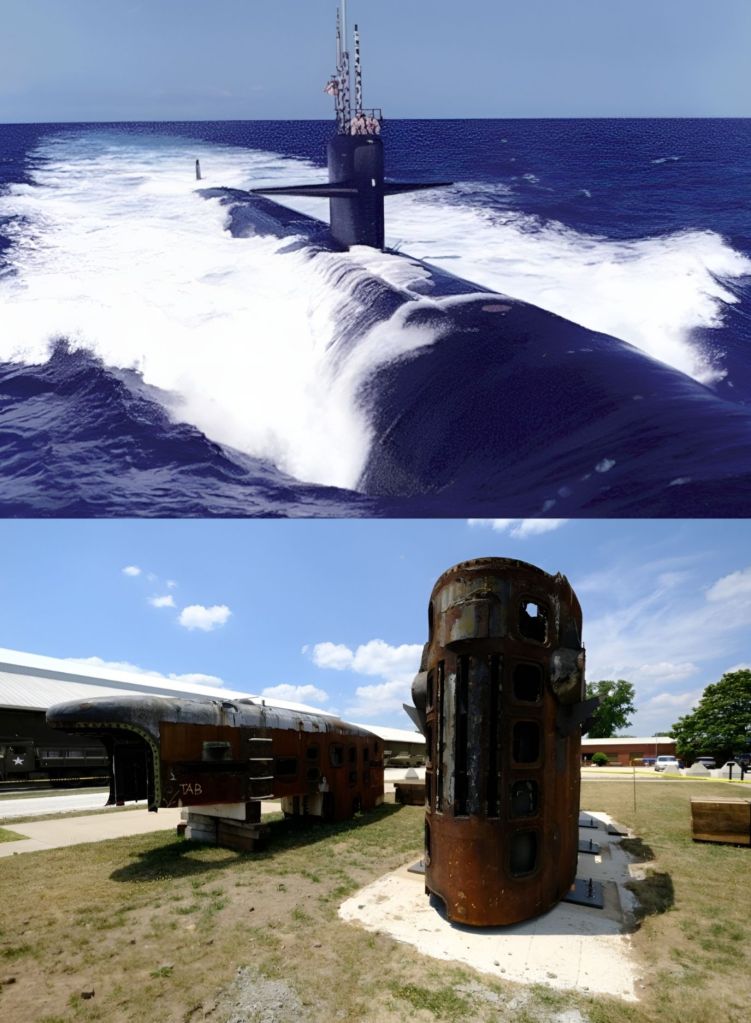
Hawaiian Operating Areas – In the summer of 1993, just northwest of Pearl Harbor, the Los Angeles-class fast attack submarine USS Indianapolis (SSN 697) operated at sea with Capt. David Zacharias and navigator Dan Eytchison on the bridge, flying the Indy Flag during active service. Years later, the submarine’s sail assembly was documented awaiting reassembly for public display at the Indiana Military Museum in Vincennes, Indiana, on June 11, 2017, marking a later chapter in the ship’s history.
-
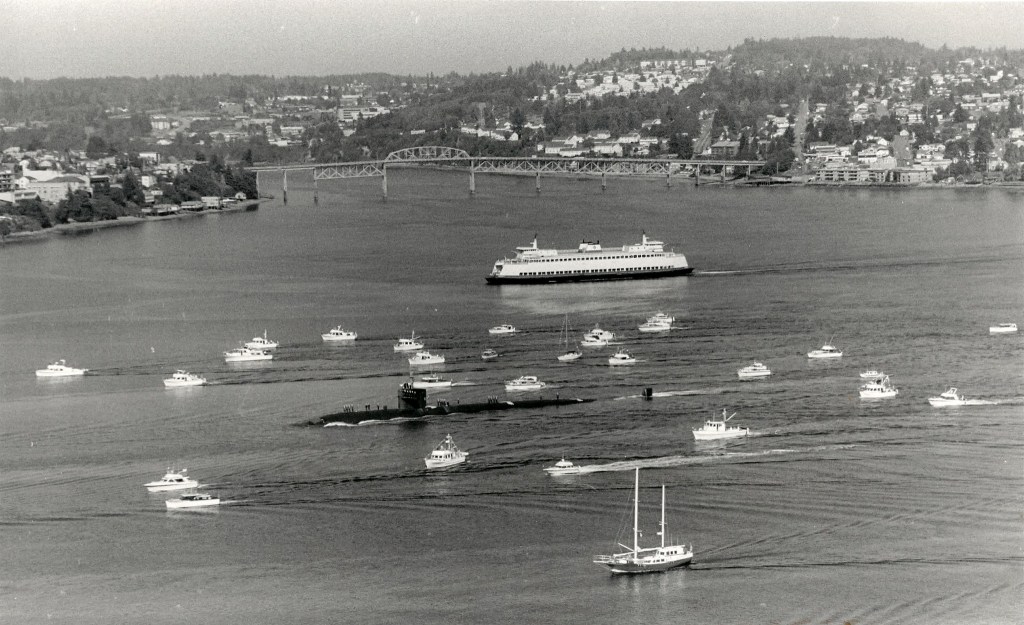
USS Bremerton Arrival in October 1986
Check out this great photo of the USS Bremerton visiting its namesake city on Oct. 4, 1986.
Kitsap Sun photojournalist Meegan M. Reid came across an actual print of this photo (which is a rare find) while getting the many boxes of film archives of the Sun ready for an office move.
Back in the day, every image that was in the paper was printed in the darkroom before it went to press, and while the Sun has an extensive collection of sports prints from those eras (since the sports editors thankfully insisted on filing them away for later use) the news photo prints were put in a box at the receptionist’s desk after they were used in the paper and anyone who came into the building could take whatever photo they liked home.
We’re betting this print never made it to that front-desk box because who wouldn’t have wanted to take this one home to hang on the wall?!?!?
-
O’Kane Cribbage Board
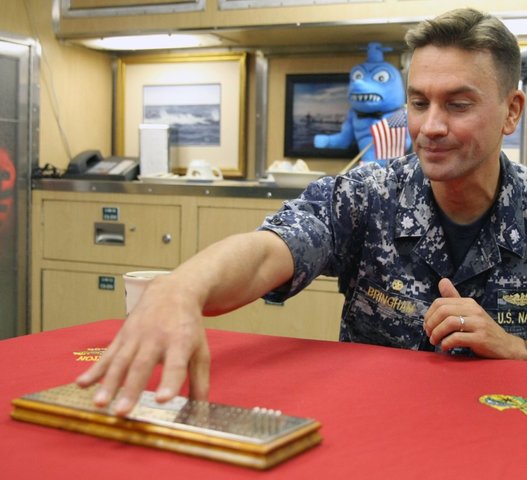
USS Bremerton’s commanding officer, Wes Bringham, and the historic cribbage board game in the ward room. The connection between the U.S. Navy and the game of cribbage is a long-standing tradition. Cribbage, a card game with a unique scoring system, became popular among sailors during long sea voyages. The Navy used cribbage to pass time, build teamwork, and keep minds active during downtime. Cribbage boards are commonly found on ships and submarines.
We share the story of the Navy’s famous Lucky Cribbage Board in our exhibit We Have the Watch, which is now open! You can learn more about the cribbage board here: https://youtu.be/RSyfI7fMp6o. It was carried onboard USS Bremerton until she was decommissioned.
O’Kane Cribbage Board onboard USS Bremerton
War hero’s artifact still rides the USS Bremerton
If you are new to the game of cribbage, watch our Educator’s video on how to play: https://youtu.be/i3KQfr76yGA
Posted by Puget Sound Naval Museum
-
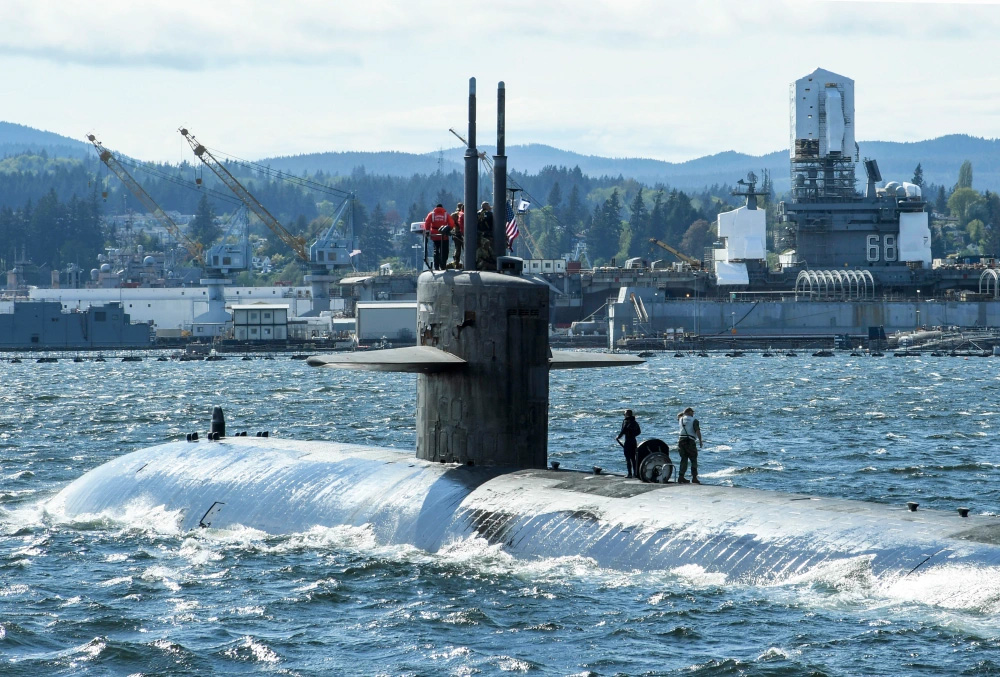
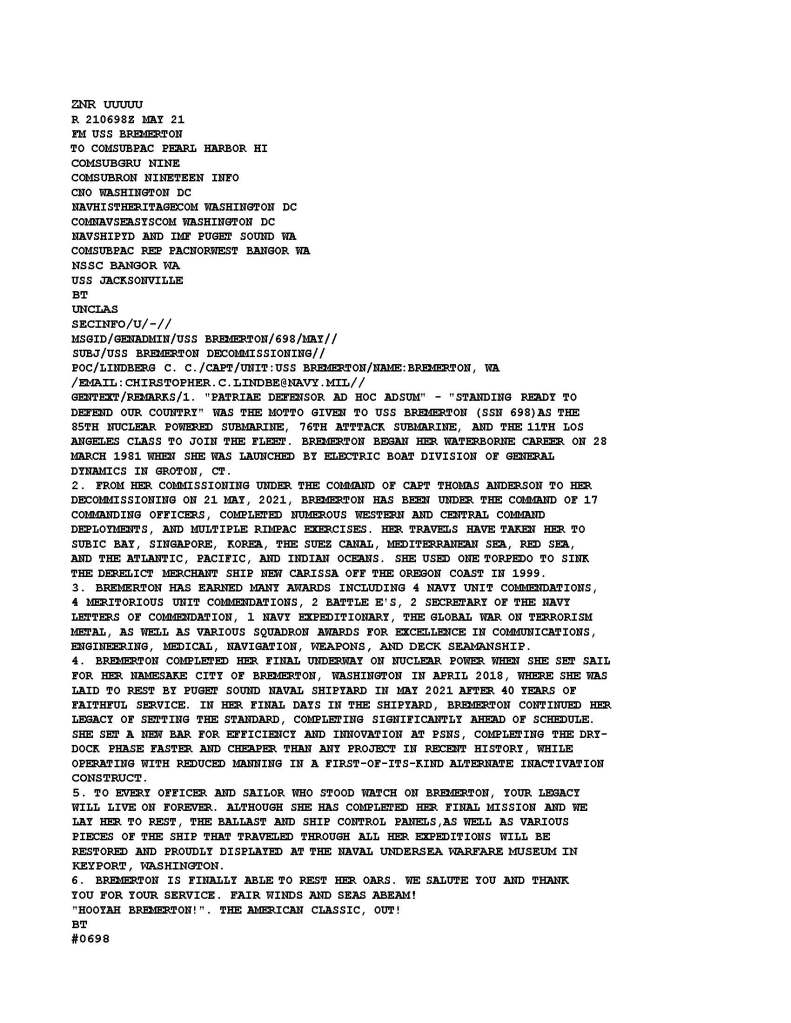
USS Bremerton (SSN-698) Decommissioned May 21 2021
Today at 1245 I officially signed over USS BREMERTON (SSN 698) to PSNS. The Bad Fish a.k.a. the American Classic is officially decommissioned. It has been an extraordinary 40 year run for the best Submarine in the US Navy. I thank each of you for your service and dedication you provided during your tenure as BREMERTON.
BREMERTON Departing.
CAPT Chris Lindberg
17 th and Final Commanding Officer of USS Bremerton (SSN 698)
-
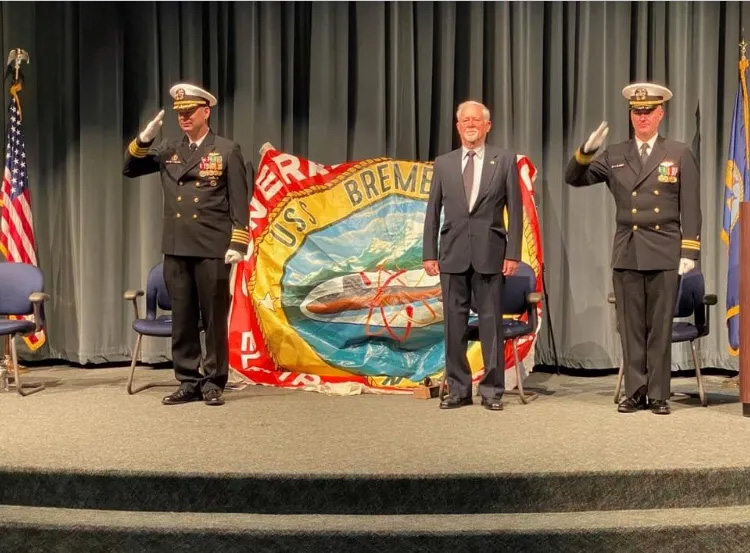
USS Bremerton (SSN-698) Inactivation Ceremony May 18 2021
USS Bremerton (SSN 698) Inactivation Ceremony – 05/18/2021
-
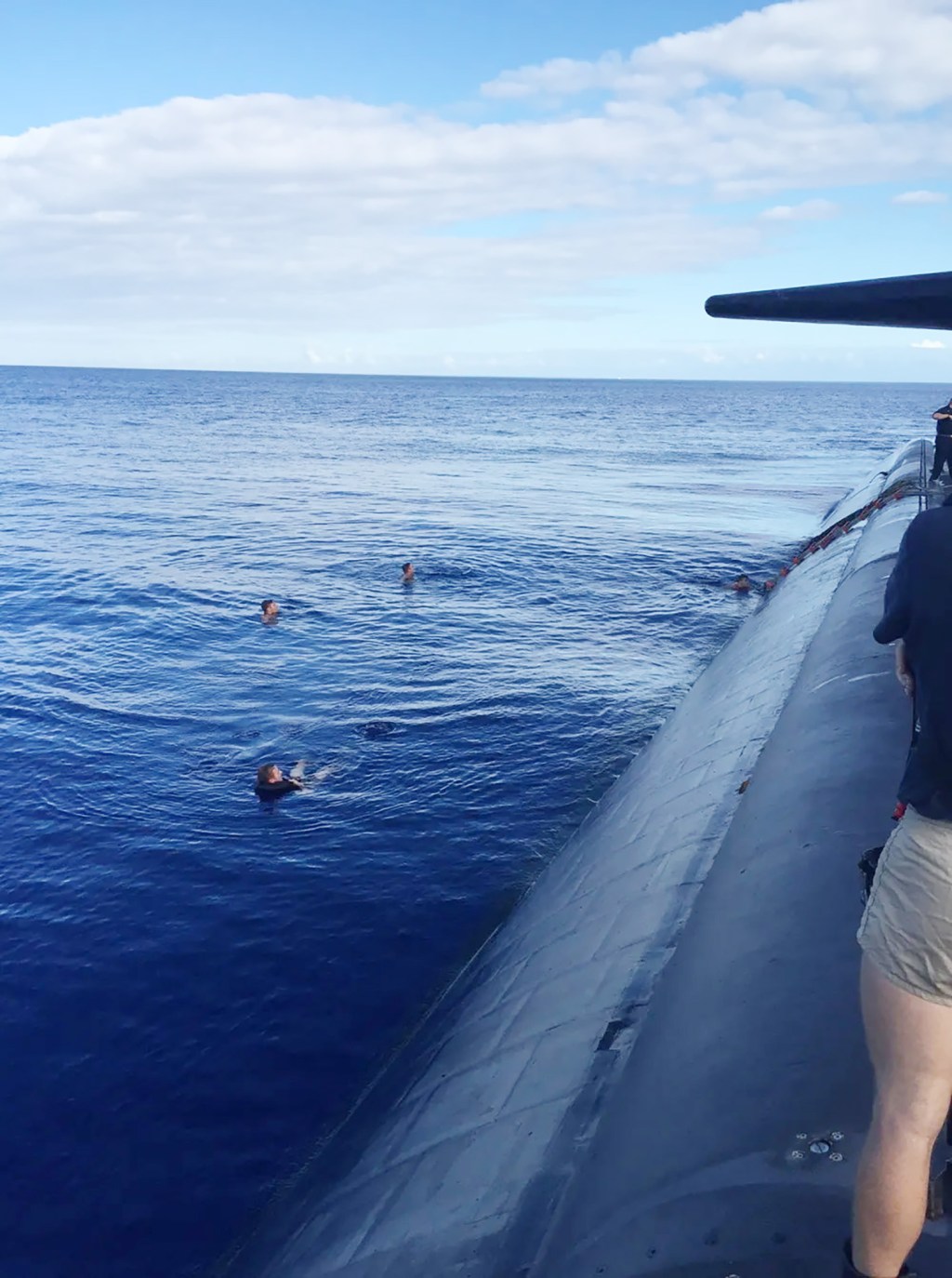
Sea Story: Swim Call August 2016
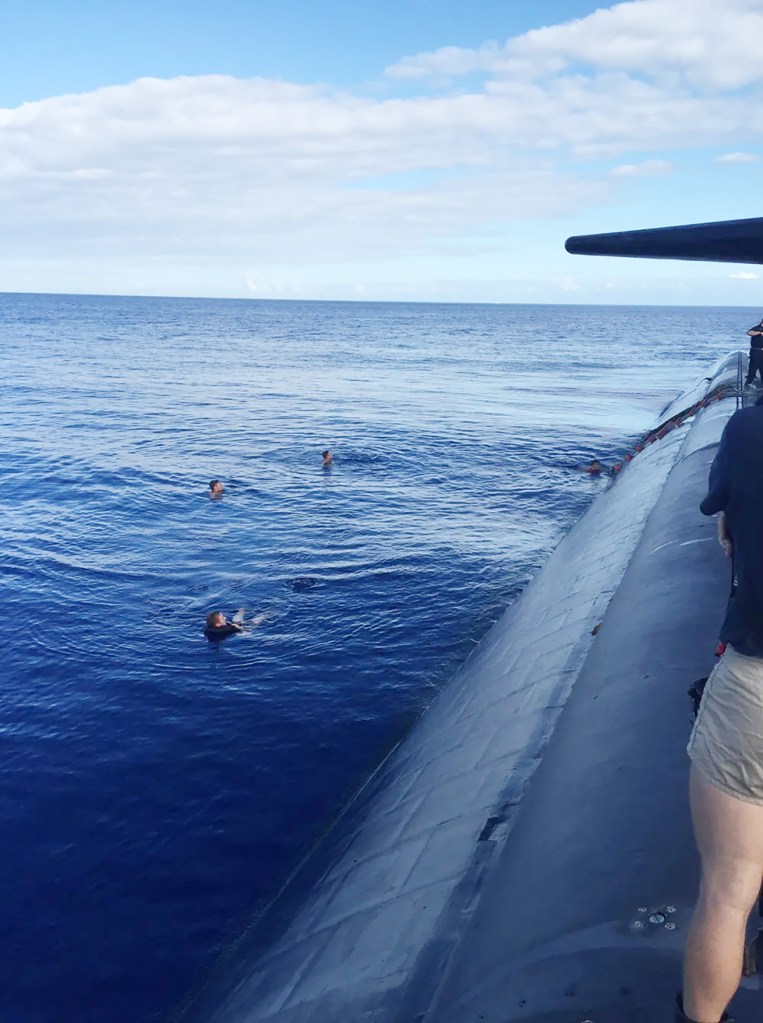
On Monday morning, BREMERTON got underway with her new CO for a scheduled two week underway to support a multinational submarine exercise. In addition to submarine tracking, the BREMERTON kept busy conducting maintenance, training, running drills and planning for an upcoming Docking Continuous Maintenance Availability (DCMAV). As a reward for all of the hard work, the Badfish squeezed in a swim call (reenlistment training) in the warm waters of the Pacific on the south shores of Oahu, prior to returning to port. – Swim calls are not as frequent as they used to be; compressed operational timelines, fleet requirements, and risk aversion have taken their toll.
CO’s context: For some, swim calls are only folklore; many can go their entire career without ever conducting one. In my 18 years of submarine service (nearly ten years of sea time), I had never even observed a swim call. That was until BREMERTON. Even before taking command, crew members were very interested in my plans and thoughts to conduct a swim call during our last underway prior to entering DCMAV (apparently my predecessor had promised such post deployment that never came to fruition due to material challenges and schedule perturbations). Being my first underway while in command, I was not keen to acquiesce. But because my crew was diligent and unrelenting, I said I would think about it and used the opportunity to do some operational planning training; challenging my team to develop an air tight plan to include, watch bills, training, and ORA (operational risk assessment) and the wardroom happily stepped to. Even with such a plan available to me, weather, seas, and traffic conditions had to be almost perfect to pull off a swim call. In my mind, I did not believe we could pull it off and gave it only a 5% chance of occurrence and went to bed that night with that solace.
At 0530 the next morning, I went to the bridge to assess wind and seas as we headed inbound. As we crossed into the lea of Oahu, wind and seas abated – just as my Assistant Navigator had anticipated and to my surprise, conditions were favorable for a swim call. The Officer of the Deck called down to control for the rifleman to report to the bridge to be stationed as a shark watch (Submariners don’t get a lot of practice shooting on the range, so opinions are divided over whether the expended ammunitions would end up in the shark or in the shark bait. But for those not afraid of sharks or the shark watch, were free to come topside for a swim.)
For most onboard, a swim call is the pinnacle of things to do onboard a submarine while at sea. Jumping from the fairwater planes is now a very unique opportunity for a US submariner (SSBN fairwater planes are too high and most SSNs no longer have them).
For the CO, a swim call is possibly the most terrifying evolution possible. Aside from all of the risks associated with sending personnel topside in the open ocean, there are 50 young excited sailors full of adrenaline looking to blow off some steam. Even with the COB topside attempting to coral the rambunctious sailors, I have never been more on edge then during my first swim call. I must have come across to my sailors as a grumpy old man.
Travis W. Zettel https://bremolympicnlus.wordpress.com/2016/10/20/uss-bremerton-captains-log-4/
-
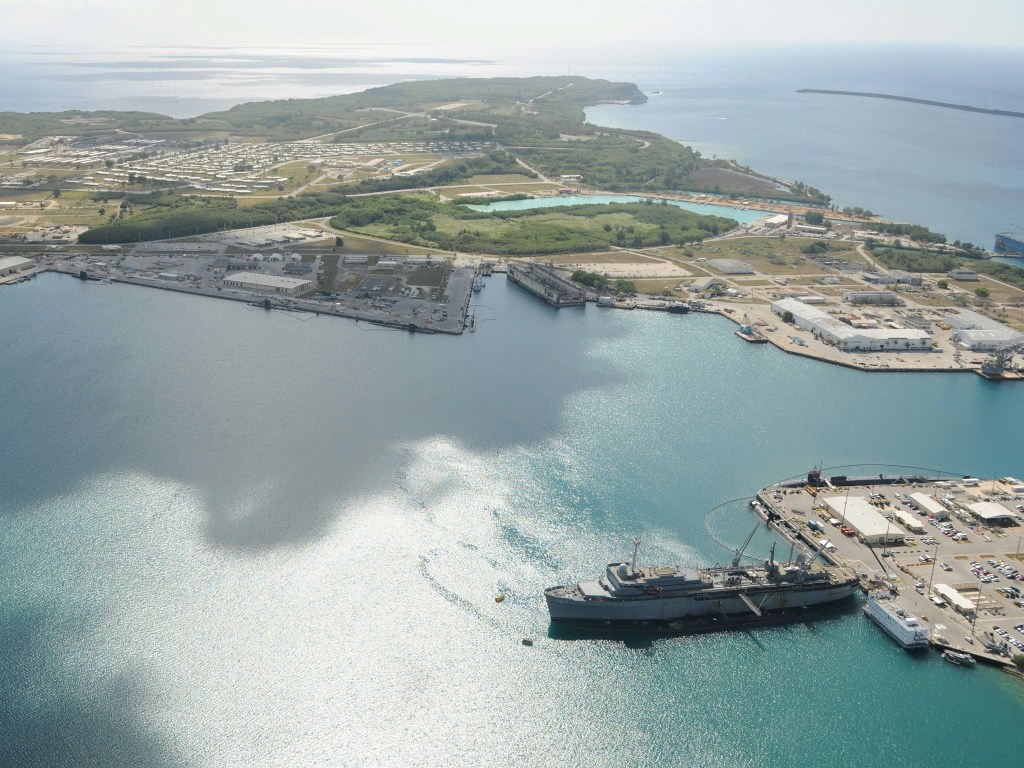
Apra Harbor Apr 13 2013
With the mooring of the Los Angeles class submarine Bremerton (SSN-698) on April 16, Apra Harbor now has seven submarines in port. This is the highest number of submarines in the harbor since the re-establishment of Commander, Submarine Squadron (SUBRON) 15 in 2001. The submarines are conducting maintenance prior to continuing their deployments. The submarines include (from top left, clockwise), the Japan Maritime Self-Defense Force submarine JS Hakuryu (SS-503), the Los Angeles class submarines Cheyenne (SSN-773), Bremerton, and Charlotte (SSN-766), Ohio (SSGN-726), the Los Angeles class submarines Oklahoma City (SSN-723), and Key West (SSN-722), and the submarine tender Frank Cable (AS-40) on 17 April 2013
-
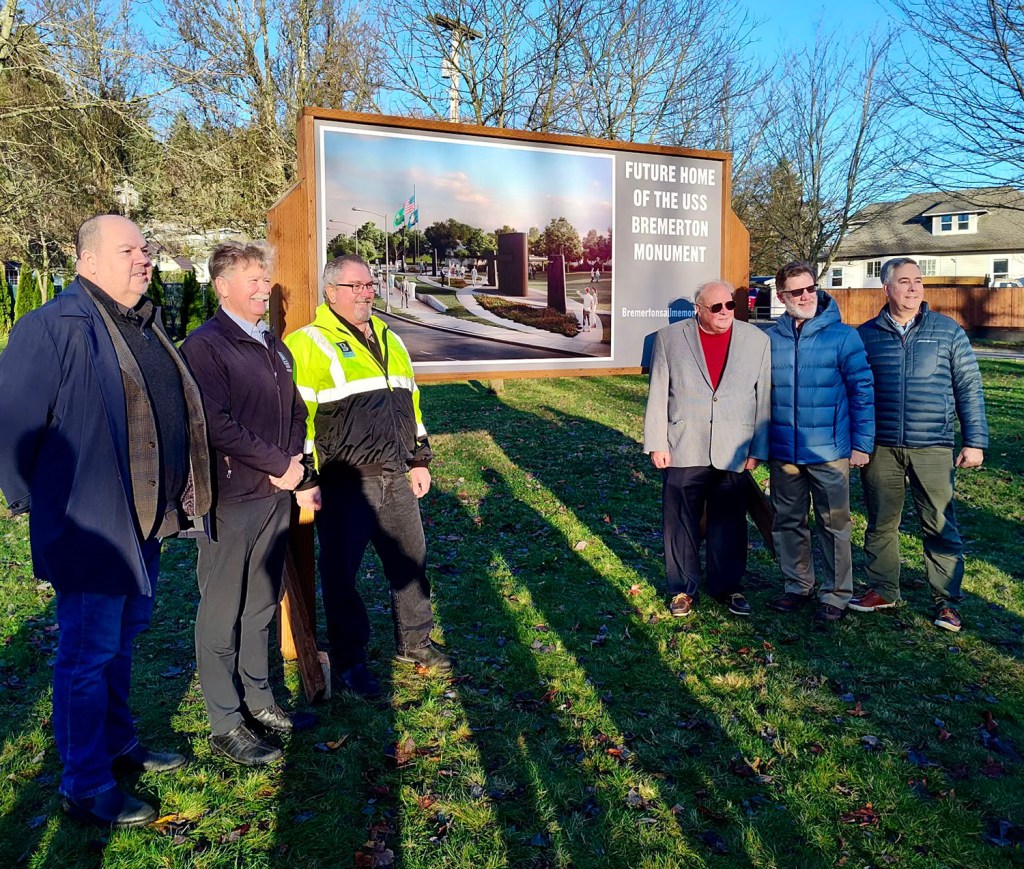
What’s going on along Charleston Boulevard?
A new sign at a grassy area near Naval Base Kitsap’s Charleston Gate is a hint at a major effort in the works.
L toR- City Councilman Michael Goodnow, Mayor Greg Wheeler, Public Works Director Chance Berthiaume, USS Bremerton CO #3 Alan Beam, USS Bremerton CO#10 Jerry Logan, USS Bremerton CO #11 Tom Zwolfer. We placed the “Future Home of the USS BREMERTON Monument at Navy League Park” sign today at First and Callow in downtown Bremerton on a brisk but sunny day. City of Bremerton Mayor Greg Wheeler joined us to say a few words about the importance of the city’s relationship with the USS BREMERTONs and the Navy. We also had Councilman Michael Goodnow, and Jim Cline from the Charleston Business District in attendance. Our Committee Chair, Jerry Logan (USS BREMERTON CO #10), welcomed those in attendance, thanked all of our partners on the project to date and gave an update on the project’s status. Thank you to Bremerton Public Works Director Chance Berthiaume and the City of Bremerton Public Works for installing the sign, with a special thanks to Josh who put it up in the rain and wind yesterday. – Tom Zwolfer (USS BREMERTON CO#11).
